Biochar gives asphalt manufacturers another ingredient to work with: carbon made from biomass that can serve as a filler or change how a binder behaves. Research has explored both routes, connecting renewable sourcing with properties that matter in pavement materials.1, 2
The distinction is useful. Replacing mineral filler changes part of the solid material in a formulation. Modifying the binder puts attention on how the material responds to heat, loading, and aging.
A renewable alternative to mineral filler
Researchers at Empa and ETH Zurich compared biochar with limestone filler in asphalt mastic—the combination of binder and fine particles. Replacing limestone with equal volumes of biochar produced little change in the unaged mastic’s flow and deformation behavior.1
That gives manufacturers a concrete reason to consider the material: biochar can take a familiar filler role while introducing biomass-derived carbon. The study evaluated that substitution directly, rather than simply adding more solids to an existing formulation.1
Supporting performance in heat
Biochar can also change the binder itself. In laboratory work on modified asphalt binder, selected biochar additions improved high-temperature stability and resistance to rutting after aging.2
Rutting is the permanent deformation that leaves wheel tracks in pavement. Binder research examines the material behavior behind that problem, giving developers a way to explore how biochar contributes under heat and repeated loading.2
A separate 2026 study of wood-biochar binders also reported improved rutting-related performance. Together, these studies make heat performance a useful focus for biochar development, alongside renewable material content.3
Slowing the effects of aging
Sunlight and oxidation provide another reason to investigate biochar. Research on conventional and rubberized asphalt found that biochar helped delay ultraviolet aging, with a stronger effect in the conventional asphalt.4
This is a different contribution from giving a surface its black color. The carbon is working within the material, influencing how it responds to exposure. It offers a performance-led reason to explore biochar as part of an asphalt formulation.4
Renewing pavement’s appearance and performance
Biochar’s black color also creates opportunities in pavement maintenance. In a surface-treatment formulation, biochar-derived pigment can help renew the dark, uniform appearance of weathered asphalt, while rejuvenating ingredients work to restore flexibility in the aged binder.5, 6
That brings appearance and preservation into the same product-development conversation. Alongside its pigment role, research on biochar’s resistance to ultraviolet aging gives manufacturers another property to explore in pavement treatments.4
Match the carbon to its role
The opportunity also connects pavement manufacturing with the forestry economy. Turning wood and sawmill residuals into asphalt ingredients gives those materials another useful destination. For regions with established forest-products industries, that could connect local biochar production with demand for road-building materials.
An alternative filler and a binder modifier create different starting points for product development. Particle size, moisture, and processing connect the biochar supplied to the role it will play.
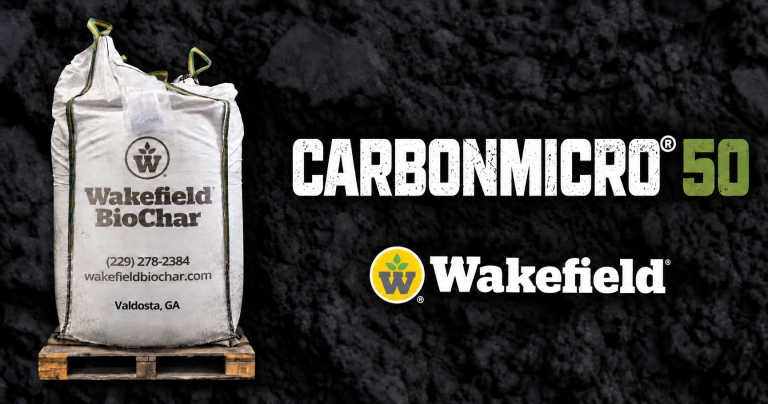
Wakefield CarbonMicro® 50 provides a fine, low-moisture wood-biochar powder. Premium Biochar LM™ offers a coarser, low-moisture input for manufacturers doing their own processing.
We can discuss material specifications, samples, packaging, and supply around your operation. Visit Concrete & Asphalt to connect with Wakefield.
Sources and notes
-
Biochar versus limestone filler 2025. Primary abstract/highlights reviewed; full repository PDF timed out. Equivalent-volume mastic comparison. Aged specimens showed reduced stiffness and greater accumulated strain; water absorption increased. This is not a full pavement or Wakefield-material trial View Source ↩
-
Aging performance of modified binder 2020. Primary repository PDF accessed and conclusions inspected. Laboratory aging and rheology support the high-temperature result; low-temperature response depended on loading. Binder tests do not establish road service life View Source ↩
-
Wood-biochar asphalt composites 2026. Institutional abstract rechecked; prior review inspected indexed methods/results. No loading recommendation or numerical footprint claim adopted. The environmental assessment used allocation assumptions that do not transfer to Wakefield View Source ↩
-
Ultraviolet aging of bituminous composites 2021. Author-institution abstract reviewed. Effects differed between conventional and rubberized asphalt. This work concerns incorporated biochar, not a finished treatment applied to existing pavement View Source ↩
-
Rejuvenating fog seals Rejuvenating oils are formulated to restore properties of aged binder. Biochar’s pigment and aging-resistance roles are distinct from that restoration mechanism. The treatment discussion describes a development opportunity; the ultraviolet-aging study in note 4 tested incorporated biochar, not a spray-applied product View Source ↩
-
Public announcement of a wood-derived pigment asphalt rejuvenator 2026. Manufacturer announcement establishes a commercial example of the combined concept. It is not independent verification of performance. No proprietary formulation, service-life percentage, raveling figure, or product equivalence is claimed here View Source ↩