
Use Biochar To Minimize Salt Damage Over The Winter
The Problem
The use of a low ash biochar can aid in the prevention of salt damage caused during winter through the use of de-icing agents on roadways and sidewalks. These de-icing agents can accumulate in the adjacent soil and have a negative impact on plant growth during spring warmup.
The Solution
Wakefield Biochar has a high surface area that will bind the de-icing salts. The high surface area of the biochar generates a large distribution of micro or mesopores.1 The greater the number of micropores, the greater the surface area and more surface sites which absorb salts.2 Biochar amended soils have commonly been shown to increase plant growth and alleviate plant stress due to drought and toxic metals in soils. The University of Toronto showed that biochar can alleviate the stress on plants caused by road salt. This study shows how plants in biochar-amended soil grow at similar rates to plants impacted by road salt.3
Biochar Application Process For Salt Damage
The recommend steps to stimulate lawn recovery after winter are:
- Core aerate the area prior to application of the biochar
- Blend biochar with compost at a 50/50 ratio. Ideally, allow to charge for at least a few days
- Top dress the biochar + compost blend at a rate of 1 cubic foot of biochar per 400 square feet
- Rake in areas that have heavy spots of biochar
- Water after application
If possible, tilling the biochar into the soil will help get the benefits of the biochar deeper into the root zone. Wakefield Biochar recommends mixing biochar at a 10% (by volume) 4 to 6 inches deep into the soil. As with top dressing, it is helpful to mix the biochar with a compost or fertilizer prior to tilling it into the soil.
Don’t worry if you can’t apply the biochar in the Fall. Biochar is stable and will not decompose for hundreds to thousands of years. Meaning that you can apply biochar anytime of year and still see positive effects come spring!
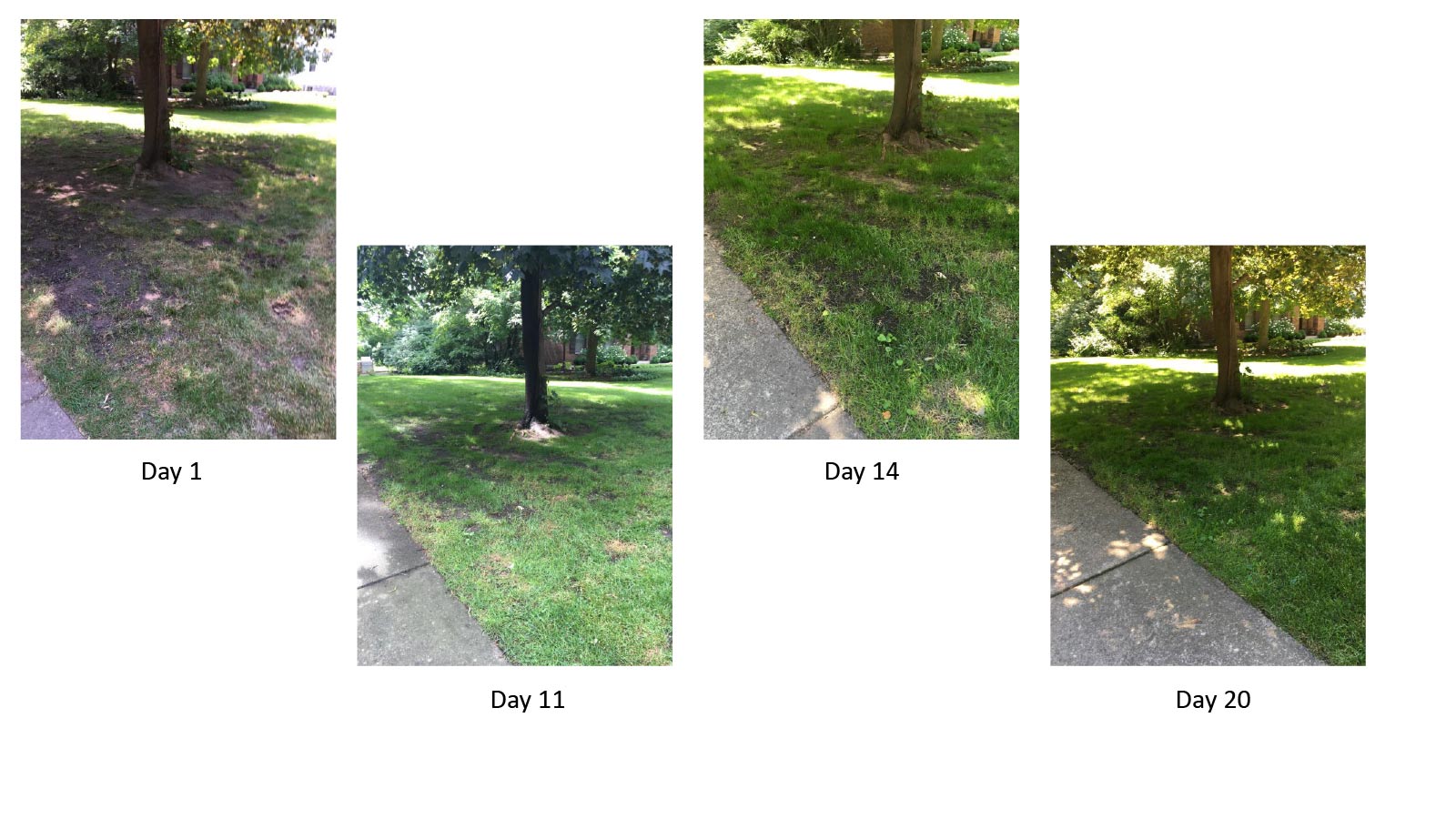
The following figure showcases soil next to a driveway in poor health (Day 1). However, the impact of biochar was noticeable after a few weeks (Day 20).
- Biochar: A Home Gardener’s Primer, Washington State University Extension Fact Sheet – FS147E, 2014 ↩︎
- Sizmur, T., et al. Biochar modification to enhance sorption of inorganics from water. Bioresour. Technol. (2017), http://dx.doi.org/10.1016/j.biortech.2017.07.08 ↩︎
- Biochar mitigates negative effects of salt additions on two herbaceous plant species. Sean C. Thomas, Susan Frye, Nigel Gale, Matthew Garmon, Rebecca Launchbury, Natasha Machado, Sarah Melamed, Jessica Murray, Alexandre Petroff, Caroyln Winsborough, University of Toronto, May 23, 2013, Journal of Environmental Management ↩︎